

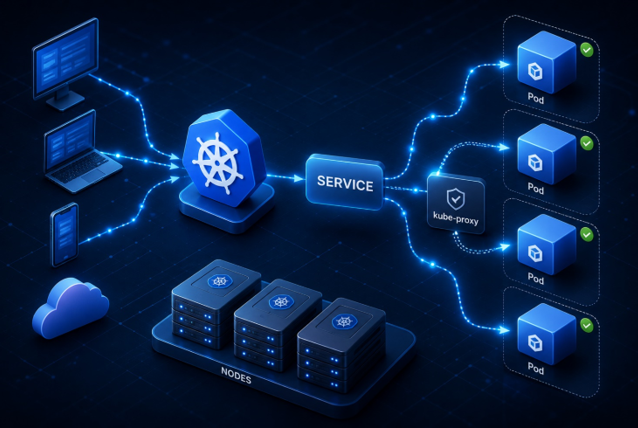
The contemporary cloud-based applications leverage microservices running inside containers which are deployed in Kubernetes clusters. The pods are continuously created and removed and they can be scaled up or down depending on requirements. Although this allows for great flexibility, there is one major issue to tackle: how to handle communication between pods having dynamic IPs?
This is where a service in kubernetes is needed. It is a stable traffic manager that makes sure requests get to the right Pods, even in very dynamic environments.
The Challenge of Dynamic Pods in Kubernetes
In Kubernetes, Pod has no life cycle. They are meant to be ephemeral, which means you can kill them or make new ones at any time. A Pod gets a new IP address every time it is restarted.
Applications which tried to communicate directly with Pods through these IPs would be broken all the time since the endpoints keep changing.
This creates a need for a stable abstraction layer that can hide this complexity and ensure smooth communication. This is exactly what a Service in kubernetes solves. It provides a consistent way to access a group of Pods.
What Is a Service in Kubernetes?
In Kubernetes a Service is an abstraction that defines a logical set of Pods and a policy by which to access them. Applications connect to the Service instead of connecting directly to individual Pods.
Traffic will then be automatically directed to the appropriate Pods, depending on the rules you have set up.
That is, even if Pods are replaced or scaled, the Service remains the same and continues to work as intended.
How a Service in Kubernetes Manages Traffic
Traffic management in service in kubernetes is achieved by using labels in the service. In Kubernetes, each Pod has labels assigned to it. The Service uses the labels to decide which Pods should receive traffic.
The Service receives a request, and Kubernetes uses internal network components to route that request to one of the matching Pods.
Kubernetes does this automatically, and you don’t need to worry about it. Traffic distribution remains the same.
Load Balancing Across Pods
It’s one of the key responsibilities is load balancing with a Service. When you have several Pods running the same application, the Service will distribute incoming requests evenly across those Pods.
It will ensure that no single pod becomes a bottleneck and helps in improving the performance of the application.
If any Pod becomes unhealthy, then the traffic of the Service would be directed towards other healthy Pods. Thus, there is an increased level of resilience and fault tolerance in the system.
Types of Traffic Routing in Kubernetes Services
The way a service in kubernetes handles traffic depends on the configuration and there are different ways to do it. Kubernetes provides several service types that determine how traffic is exposed and handled.
ClusterIP Service
This is the default type. The Service is exposed only within the Kubernetes cluster. It is mostly used for inter-service communication inside a microservice.
NodePort Service
NodePort exposes the Service on a static port on each node’s IP address. This allows access from the outside using the node’s IP address.
LoadBalancer Service
This type works with cloud providers to balance external traffic using a cloud load balancer. It is preferred to be used for production environments.
ExternalName Service
This type maps a Service to an external DNS name that can be used by Kubernetes workloads to communicate with external services.
Each of them is involved in how traffic is managed and routed within and outside the cluster.
Service Discovery Made Simple
In traditional systems, the developer has to manually configure the IP addresses to wire the services together. This complexity is abstracted away by service discovery in Kubernetes.
Every Service receives a DNS name inside the cluster. The application can use it instead of using the unreliable IP address of the Pod.
This makes it very easy and reliable to communicate between services. In service in kubernetes , a service is basically a bridge between different parts of an application.
Role of kube-proxy in Traffic Management
There is a Kubernetes component named kube-proxy responsible for handling network policies.
kube-proxy is running on each node and is responsible for forwarding traffic from Services to the correct Pods. Requests can be channeled in an efficient manner depending on the present availability of the pods.
Routing rules are constantly being adjusted depending on whether pods are added, deleted or changed to make sure that requests are always being routed to their proper destinations.
Scaling Applications Without Breaking Connectivity
The key benefit of Kubernetes is the ability to scale out. Traffic increases, new pods are automatically created to accommodate the load.
A service in kubernetes makes sure these new Pods get instantly included in traffic routing, without any manual changes.
Similarly, if the traffic is reduced and Pods are taken out, then the Service will stop making any requests to these Pods. This makes it possible for applications to scale up without any hassle at all.
Real-World Example of Service Traffic Management
Consider an example of streaming services with several microservices working at the back end like user authentication, video processing, and recommendations.
All these services work in several pods for handling traffic effectively. None of the components is aware of the Pod IP addresses but communicate with each other via Kubernetes services.
For example, when the frontend requests video recommendations, it invokes the recommendation Service. The Service will then route the request to one of the available Pods that run that microservice.
Why Services Are Critical in Kubernetes Architecture
Without Services, Kubernetes would be really hard to manage. Changing Pod IPs would break applications constantly, and developers would have to manage endpoints manually.
A service in kubernetes offers:
- Stable network endpoints
- Load Balancing (Automatic)
- Seamless service discovery
- High availability and fault tolerance
- Large Scale Microservices Communications
These characteristics make Kubernetes a practical option for real world production systems.
Conclusion
Service in kubernetes is the most basic unit of Kubernetes architecture, which provides management of the traffic flow between pods. It takes care of the Pod’s changing IP address, making sure there is a proper and smooth traffic flow to healthy pods.
Kubernetes Services provide load balancing, service discovery, and seamless scaling so you can build modern cloud-native applications that are resilient, flexible, and production ready.
