

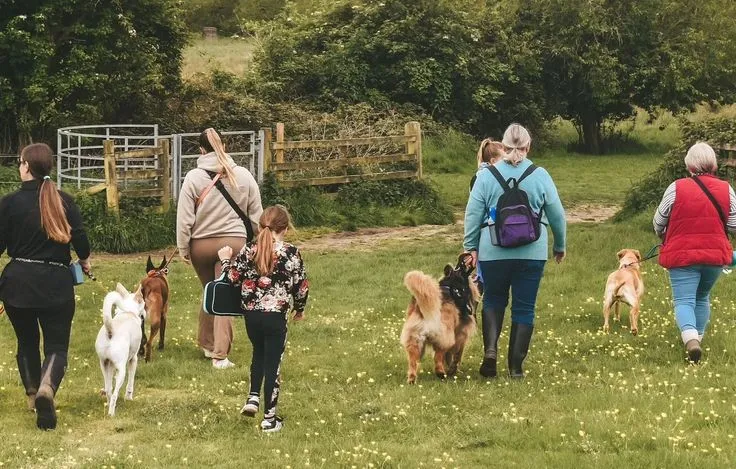
Dogs that are well-behaved don’t always get along with others. A dog can come when called at home but be distracted, nervous or excited when meeting strangers or other dogs. Social skills will be developed through experience, guidance and repetition. Dogs can be trained to respond correctly without interacting with all that they come across. Knowing this can be helpful for owners to navigate everyday walks, introductions and outings.
Social Skills Go Beyond Friendly Behavior
For many owners, socialization involves getting a dog to greet as many people and animals as they can. That can leave out an important skill: learning to be calm without engaging in interaction.
During a walk, a dog can meet another dog and proceed on the walk with its owner. It’s a good social occasion, even if it doesn’t have a greeting. Likewise, a dog can learn that the presence of strangers is not to be taken seriously by calmly observing them.
Effective socialization training for dogs should therefore focus on appropriate responses, not simply increasing the number of interactions.
Pay Attention to Individual Reactions
Dogs are not all the same and have varying pasts. Some people are comfortable with new situations, and others take more time to get comfortable.
Owners should be aware of body language when encountering new situations. Posture, motion, attention, and/or voice may change when a situation is getting too challenging.
For instance, if a dog keeps trying to distance itself from another dog when the latter approaches, giving it more space is probably the best approach, not bringing it closer. Providing space may provide a more conducive environment for learning without stress.
The aim is not to build confidence. It’s designed to assist the dog to cope with it at a manageable level.
Training Creates Useful Alternatives
Dogs must be taught to do something other than what you don’t want them to do. Training can provide them with real-life behaviors to employ when something exciting or new comes along.
Depending on the situation, it may be helpful to respond with:
-
Checking in with the owner
-
Walking calmly beside the handler
-
Responding to a familiar cue
-
Waiting rather than rushing forward
-
Settling when excitement increases
These behaviors can be practiced in less challenging settings before attempting them in the school setting. The more reliable the dog is, the more distractions can be added to the mix.
How a Class Can Help
A dog behavior class with structure can provide the opportunity for dog owners to practice these skills in a controlled environment while there are distractions. Close contact with other dogs and humans can provide beneficial learning opportunities for the dog and instruction for the owner.
It is not necessary to have all the dogs interact with each other. Rather, dogs can be taught to be attentive to what’s going on around them while different activities take place.
Owners also have the chance to closely watch their dog’s behavior. They may observe that some distances, movements or areas are easier or more difficult for the dog to focus on.
Avoid Pushing Dogs Too Quickly
A frequent error is to make things harder when they aren’t ready. If the first few tries are successful, an owner may get closer to another dog, but when he does, the dog becomes overwhelmed.
It’s important to take it slow. When the dog doesn’t respond to familiar cues, or becomes very distracted, the exercise can be made easier.
Practice should be successful in providing the dog with repeated opportunities to make an appropriate choice. With the passage of time, these decisions can become more comfortable and easier to make again.
Make Social Skills Part of Everyday Life
Social learning doesn’t need to occur just in formal sessions. Owners can be calm in the house, during visits, walks and when out in appropriate places.
A dog can be trained to not be reactive when a stranger walks by, wait for a stranger to come to them, or pay attention to another dog.
These behaviors can become routine with short, regular practice. Everyone in the family must have similar expectations for the dog so that it is given consistent guidance.
Know When Additional Guidance Helps
Other dogs might have social issues due to fear, frustration, past experiences or other behavioral problems. If reactions are hard to handle, their owners will need professional advice to interpret their behavior and select the right training method.
A trainer can also be able to make changes to the difficulty of the exercises and demonstrate to the owner what to do when the training doesn’t go as planned.
Conclusion
Social skills are developed through carefully planned experiences, good communication and progressive practice. Socially able dogs don’t have to greet all the animals they meet. Being able to stay calm, react to their handler, and make the right decision in the presence of distractions can be much more beneficial in life. If the dog owner is looking for more structure in the learning of their dog, then CanineMoxy.com has some professional training resources and options that they might want to check out.
